
Prometheus between Olympus and Silicon Valley
The history of Western philosophy can be read, without excessive distortion, as one long argument with Prometheus. He is sometimes admired, frequently celebrated, and only rarely criticized.

The Titan Who Never Sleeps
Some myths do not age. They refuse to, because they do not describe the past — they illuminate the permanent architecture of human experience. The story of Prometheus speaks to us still, even to those who stopped believing in Zeus long ago. To understand the Titan, you need only have studied one recurring human type: the man who knows that what he does is forbidden, who presses forward regardless, convinced that the benefit justifies the transgression — and that he, unlike all the others, will somehow escape the reckoning.
The history of Western philosophy can be read, without excessive distortion, as one long argument with Prometheus. He is sometimes admired, frequently celebrated, and only rarely criticized with the seriousness the case demands. Socrates refused to play his role. Francis of Assisi would have regarded him with quiet compassion. Goethe wrestled with him through Faust and, partially, managed to transcend him. Marx proclaimed him a martyr. Silicon Valley made him the patron saint of the corporation. In each era, the myth absorbs the age’s deepest anxieties and reflects them as glory.
The argument of this essay is simple and, I suspect, unwelcome: Prometheus is the symptom of a disease that the West has mistaken for vitality. The confusion between hubris and grandeur, between stealing fire and receiving it as a gift, between domination and genuine liberation, has produced across five centuries not a culture of free men but a remarkably efficient civilization — one skilled above all at disguising its own chains.
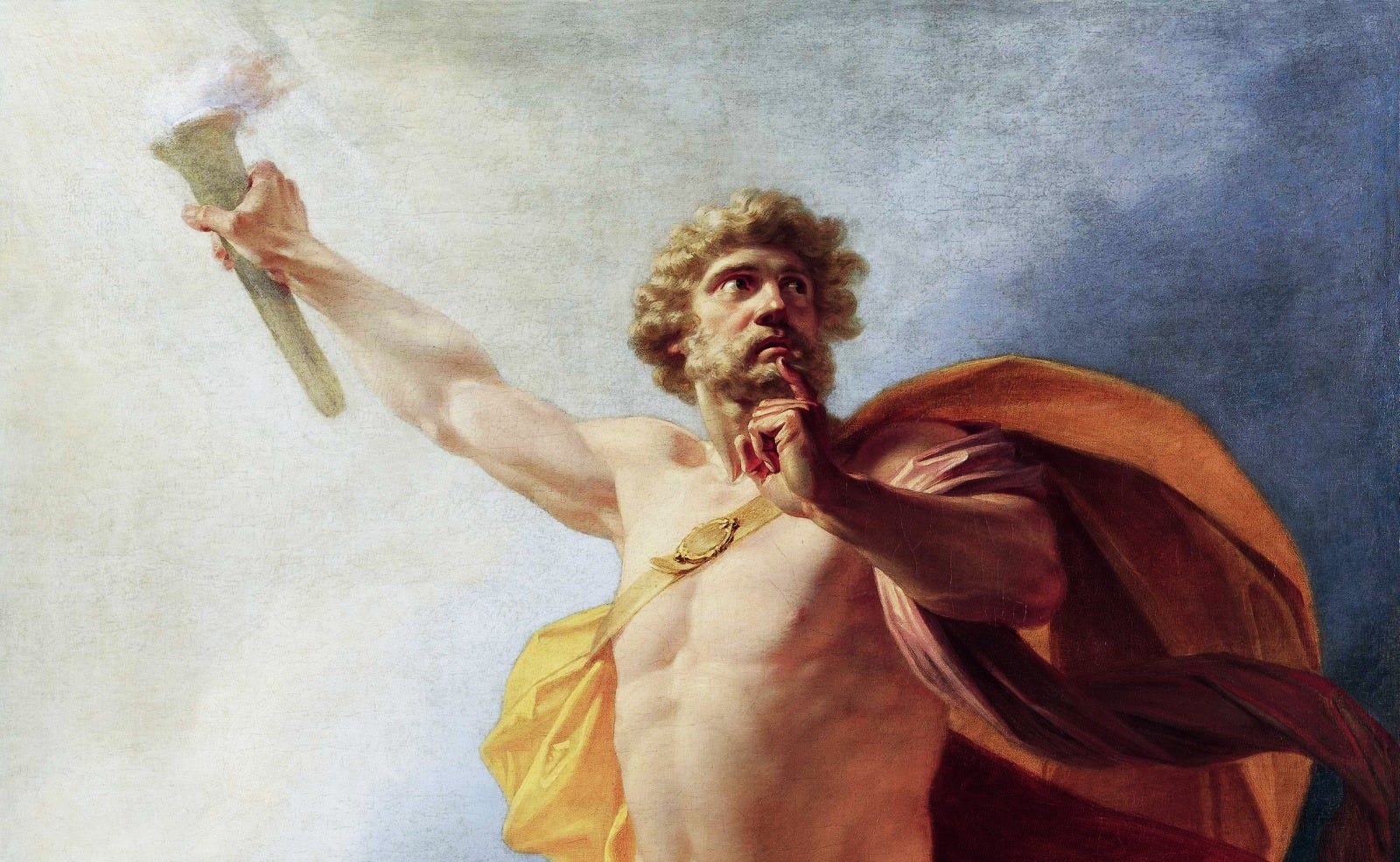
The Name Before the Deed
Prometheus is the son of Iapetus and Clymene, grandson of Ocean, brother of Atlas and Epimetheus. His name — Promētheus — means “the one who thinks ahead,” who acts by anticipation and foresight. His brother Epimetheus is the opposite: the reflective type, the retrospective soul who thinks only after the fact and spends his life paying for it. The Greeks, with that anatomical precision they applied equally to body and psyche, encoded the entire drama of human cognition in the names before the story begins.
That is worth pausing on. Before any theft, before any punishment, the name itself is already a philosophical sentence. Prometheus does not stumble into transgression. He walks in with his eyes open. This is what separates him from the merely reckless, and what makes his story genuinely tragic rather than simply cautionary. He is not ignorant of the cost. He has calculated it. He proceeds anyway.
Karl Kerényi and Mircea Eliade, approaching the myth from different methodological directions, both arrived at the same essential observation: Prometheus belongs to the typology of the divine trickster, that figure who explores with exuberant energy the infinite field of possibility, defying precedent and transgressing the limits of the existing order.
In his study The Forge and the Crucible (1956), Eliade identified a democratic — even outlaw — impulse at the heart of the myth: the sacred is confiscated so that it may serve the profane world. Every metallurgist, every engineer working near a reactor core, understands at some wordless level the risk of fire escaping its proper channel.
The Deception at Mecone
The first great confrontation between Prometheus and Zeus takes place at Mecone, which some ancient sources identify with Sicyon in the Peloponnese. Men and gods are negotiating the apportionment of the sacrificial animal — a foundational act, since it determines the ratio of obligation between the human and divine orders. Prometheus slaughters a bull and divides it into two portions: one containing the bones and hide, covered in glistening fat; the other containing the meat and organs, concealed beneath the stomach. He invites Zeus to choose.
Zeus chooses the fat. He chooses, that is, the appearance of abundance over its substance. The Hesiodic text deliberately leaves unresolved whether Zeus knew what he was choosing and preferred to be deceived, to have grounds for punishment. This ambiguity is not sloppy mythography. It is the most honest description of the relation between power and freedom that ancient literature affords us. The ruler who constructs the occasion for transgression to justify the punishment he already intends — that is a political observation as fresh as this morning’s newspaper.
The consequence is swift. Zeus withdraws fire from mankind. He does not destroy it — he withdraws it. This matters. Human beings are left with the memory of warmth, forced to live in the cold knowledge of what they once had and have no longer. The cruelty is precise. It is the cruelty of deprivation rather than ignorance, and deprivation, as every political theorist since Tocqueville has understood, breeds a particular and dangerous kind of longing.
The Theft, or the Metaphysics of Transgression
Prometheus does not negotiate. He does not petition. He steals. This choice — and it is emphatically a choice, made by a being who foresees its consequences — is the moral crux of the myth, and it deserves more serious examination than the Romantic tradition has been willing to give it. Theft is, by definition, the gesture of one who lacks legitimate authority. Prometheus, who is no mortal, who suffers no material deprivation himself, nevertheless chooses the path of the dispossessed. He steals the seeds of fire from the sun and conceals them in a fennel stalk.
The gesture is almost ostentatiously humble in its means. A fennel stalk. Not a divine chariot, not a cosmic battle — a hollow reed. And yet the consequences are total. Fire, in this reading, is not a mere physical element. It is the capacity to transform matter, to impose human intention upon the resistance of the natural world. It is, in Plato’s formulation from the Protagoras, the root of all technē — craft, technique, the practical arts that constitute civilization. What Prometheus gives mankind is not a tool. He gives mankind a mode of being. And this is precisely why Zeus is so enraged: not because he has lost a possession, but because mankind has acquired a resemblance to the gods that was never intended, was never earned, and cannot now be recalled.
Plato is careful to note, however, that technē alone is insufficient to found a political community. The arts of production and survival do not, by themselves, produce justice. For that, Zeus must separately bestow upon men the gifts of shame and righteousness — aidōs and dikē — without which the human animal, however technically accomplished, will simply destroy itself in competition. Here, the myth encodes a permanent truth that the modern world has been industriously forgetting: mastery over nature does not entail wisdom about how to live together. The two gifts are distinct. Confusing them is, itself, a form of hubris.
The Punishment, or the Anatomy of Hubris
What follows is punishment, and what punishment. Zeus chains Prometheus to a rock in the Caucasus — some ancient sources say Elbrus, others Kazbek, as if the specific geography of suffering matters less than its remoteness from civilized life. An eagle, offspring of Typhon and Echidna, tears out his liver each day. Each night, the liver regenerates. Each morning, the violation recommences. Without end, without interruption, without any hope of conclusion arising from within the logic of the sentence itself.
The liver is not an arbitrary choice of organ. For the ancient Greeks, it was the seat of passion, the source of desire, the organ of vital will. The rational soul dwelt in the head; the animating force, the thymos that drives a man to act against his own apparent interest, resided in the viscera.
Zeus does not attack the mind of Prometheus because the Titan’s intellect cannot be broken, and Zeus knows it. He targets, day after day, the very organ that produced the will to steal. The punishment is not retributive in any simple sense. It is diagnostic. It is Zeus saying, repeatedly and without conclusion: this is where it comes from. This is the source.
Eric Voegelin observed that the characteristic disorder of the modern soul is the refusal to accept the limits of the human condition — what the Greeks called the metaxy, the in-between, the realm that is neither fully divine nor merely animal. Prometheus inhabits the metaxy but refuses its structure. He reaches upward without remainder, without the acknowledgment of limit that constitutes genuine human dignity. The eagle is simply what reality looks like when it answers such a refusal. Not cruelty from the outside, but consequence from within the nature of things.
And yet Prometheus endures. He endures because he carries within him the knowledge of the future — that Zeus is threatened by a fate he cannot forestall, that the Olympian order is not eternal, that time and truth are on no tyrant’s side. This foreknowledge is his final weapon. The powerful cannot ultimately break the man who knows how their story ends. There is something here that is genuinely admirable, and the tradition that has admired it is not simply mistaken. But admiration for endurance is not the same as endorsement of the original act. The Romantic confusion between these two responses has cost Western culture more than it has acknowledged.
The Romantic Temptation and Its Costs
Percy Shelley gave the Romantic imagination its definitive Prometheus. In Prometheus Unbound (1820), the Titan defies, creates, and prevails — without consequence, without remainder, without the weight of responsibility pressing back upon the original transgression. Shelley does not speak of punishment as anything but injustice. He does not entertain the possibility that the order violated had any claim upon the violator. For Shelley, pride is simply greatness, and an excess of voluntarism is the very definition of freedom. The myth, in his hands, becomes a poem about the unlimited creative will, which is to say it becomes a poem about the nineteenth century’s understanding of itself.
C. S. Lewis saw what this amounted to with characteristic clarity. In the image of the unbound Prometheus, he recognized a poeticized Lucifer — the spirit of negation whose defiance is, in the end, sterile, because it has no content beyond itself. The Romantic reading is seductive precisely because it preserves the grandeur of the Promethean gesture while abolishing its cost. This is a myth with the tragedy excised. And myth without tragedy is not wisdom — it is flattery. It tells the reader what he wishes to hear about the nature of his own ambition.
Karl Marx made the admiration fully explicit. In the preface to his doctoral dissertation, he proclaimed Prometheus “the noblest of saints and martyrs in the philosophical calendar.” This is revealing in ways Marx did not intend. What he was endorsing was not merely a historical figure from Greek myth but an entire posture toward reality: the conviction that existing order is by definition unjust, that transgression against it is by definition noble, and that the costs extracted by reality from those who ignore its structure are by definition illegitimate. This is not a political theory. It is a theodicy of rebellion — and like all such theodicies, it has a pronounced tendency to produce suffering it cannot account for.
Liberation, Deliverance, and the Ring on the Finger
Heracles eventually frees Prometheus — and this, too, is dense with meaning. The liberator is the son of Zeus, which is to say that freedom comes, ironically, from within the order that imposed the chains. This is not a political contradiction the myth seems eager to resolve. What it does insist upon is the form of the liberation: Prometheus is freed, but he must wear forever a ring made from the iron of his chains, set with a stone from the Caucasian rock. The symbol of subjugation becomes an ornament. The memory of bondage is worn on the body of the free man.
This detail, easy to overlook in the drama of the liberation itself, may be the most honest moment in the entire myth. Freedom, it says, is never total. The man who has been chained carries the chain, transformed but not absent, into whatever life comes after. Liberty is not the absence of constraint but the capacity to bear constraint with dignity, to convert what binds you into something you can live with. This is a deeply conservative insight, and it is not an accident that the tradition of unrestricted Prometheanism — from Shelley through Marx to the present — has consistently refused to notice it.
The Titan in a Necktie
Prometheus has not died. He has changed his address. Today, he works with quantum computing algorithms and large language models. He appears on the cover of Forbes and speaks at Davos about disruption and the democratization of knowledge. He has replaced the fennel stalk with a term sheet and the stolen fire with a data pipeline. The mythology has been thoroughly updated. The underlying grammar has not changed at all.
The Industrial Revolution forced every serious Western thinker to confront technology not merely as an instrument of labor but as an ontological horizon — a new way of being in the world that restructures everything it touches, including the human beings who wield it. What Prometheus gave mankind was not a tool. He gave mankind a regime. And regimes, as any honest political philosopher will tell you, have consequences that exceed the intentions of their founders by several orders of magnitude. The factory, as one German writer observed, destroys the very labor it accelerates. The algorithm that promises to connect humanity is revealing, year by year, a remarkable capacity for fragmentation.
What is problematic is not knowledge itself. The genuine danger lies in the absence of the moral compass capable of orienting the cognitive enterprise — not science, but the absence of conscience. This distinction, obvious to any serious reader of the myth, is precisely what the Promethean imagination in all its modern forms has consistently refused to draw. It is also the distinction upon which civilization has always, finally, depended.
At the intersection of machine and man, a new gnostic creed is taking shape: transhumanism, which promises not to improve the human condition but to abolish it entirely, to engineer a successor to the species that will finally be free of the limitations Zeus imposed. Here, the Promethean impulse reaches its logical terminus. The Titan no longer steals fire from the gods. He intends to become one. This, too, the myth anticipated. It is understood that the logic of transgression has no natural stopping point. One theft makes the next easier to justify. The man who crosses the first line in full knowledge of what he is doing will always find a reason to cross the second.
What the Myth Knows That We Have Forgotten
The story of Prometheus is not a story about fire. It is a legend about the price of solidarity with the weak, about the peculiar courage of anticipatory knowledge, and about what happens to the order of things when generosity escapes the structures that make it sustainable. But it is also, read with full and unromantic attention, a story about the necessity of limits — not limits imposed by cowardice or convention, but limits that inhere in the structure of reality itself, in what Voegelin called the order of being. The myth does not argue that limits are comfortable. It argues that they are real. That is a harder and more important claim.
The hero’s journey, as Joseph Campbell understood it, requires the descent as well as the ascent, and the wound is not incidental to the story but constitutive of it. A Prometheanism without the wound, without the eagle, without the cold rock and the daily horror, is not an improvement on the original. It is an evasion of what the original was trying to say. The man who steals fire without accepting responsibility for the conflagration he may cause has not, in any serious sense, grown up. He has simply acquired power without wisdom, which is the definition of the adolescent — and also, increasingly, of the age.
Roger Scruton spent much of his intellectual life trying to articulate why the inherited forms of human life — its institutions, ceremonies, pieties, and limits — are not obstacles to freedom but its preconditions. The Promethean temptation, in his analysis, is the permanent danger posed to the modern age: to mistake the destruction of structure for the discovery of liberty, and to discover too late that you have not removed the ceiling but demolished the floor.
The Titan on the rock — liver torn open, eyes wide, enduring without end — is not simply a victim of divine injustice, though he is that. He is the image of a truth we keep being offered and keep declining: that the fire which warms can also burn, that the gift freely stolen is never freely given, and that the man who acts in full lucidity, with open eyes and clear knowledge of the cost, bears a weight of responsibility that no subsequent suffering, however extreme, can discharge.
We built a civilization on his model.
We called it progress.
We are still counting the cost.